

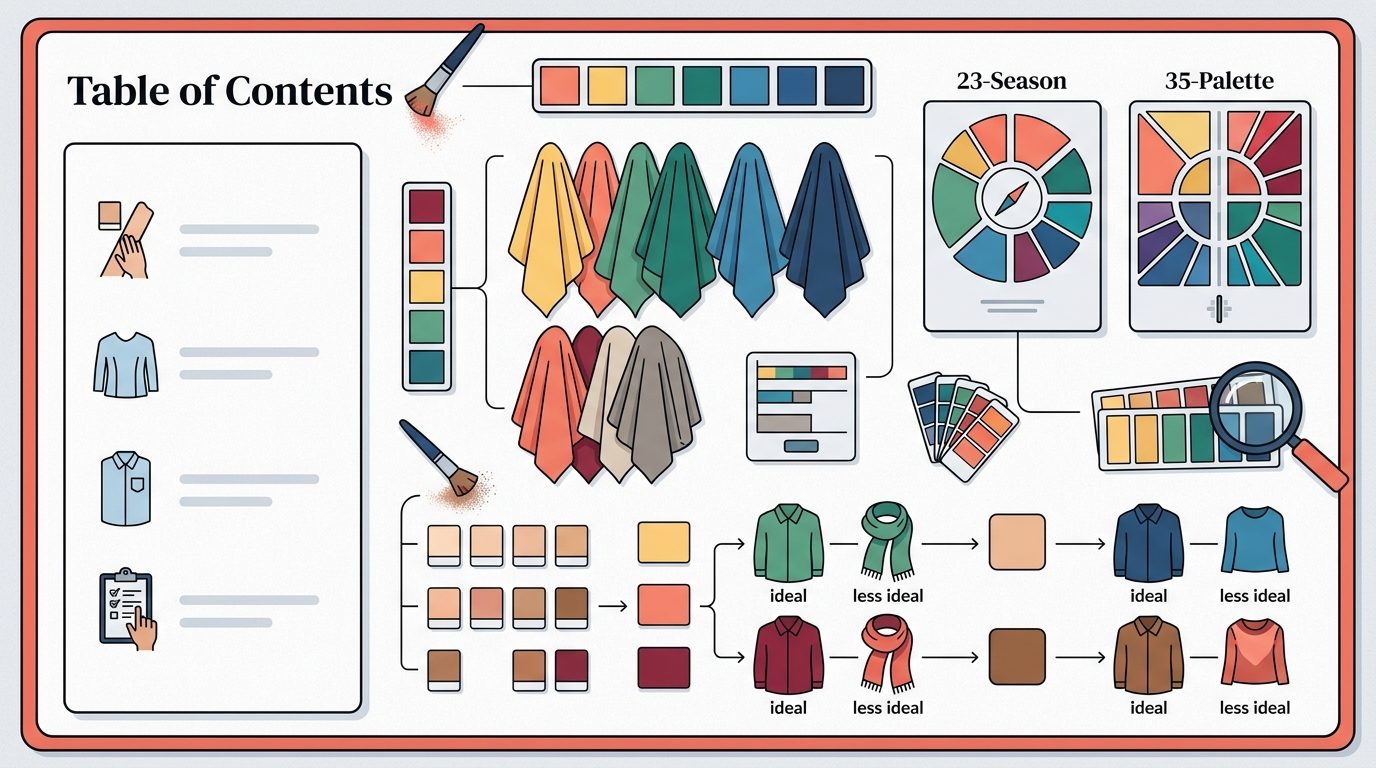
Choosing clothing colors that suit your skin tone begins with identifying your underlying undertone, not just your surface skin color. ATX Color Studio helps clients in Austin and worldwide navigate this process using advanced 23-Season and 35-Palette systems. This guide covers how to accurately determine your undertone and how to apply that knowledge to build a practical, flattering wardrobe.
Undertone Identification
Understanding your undertone is the foundation of any effective color strategy. Undertone is the subtle hue beneath the surface of your skin, which remains consistent regardless of your surface skin color. You can be fair, medium, or deep in complexion and still have any of the three main undertone categories. Identifying this correctly is the first step in choosing clothing colors that suit your skin tone.
The Three Main Undertone Categories
There are three primary undertone categories that dictate how colors interact with your complexion. Warm undertones feature yellow, peach, or golden hints. Cool undertones display pink, blue, or red hints. Neutral undertones are a mix of both warm and cool tones, offering the most versatility in color selection.
Why Surface Color Is Misleading
Many people assume their skin color alone determines their best clothing colors. This is a common misconception. Two women can both have blonde hair and blue eyes but belong to completely different seasonal color groups because their undertones, values, and intensities differ. Professional draping is essential because it reveals how your skin reacts to specific colors in real time, rather than relying on a static visual guess.
The Limitations of Home Tests
Popular home tests, such as checking vein color, are often unreliable. Vein color can change based on lighting, skin thickness, and even your body temperature at that moment. Additionally, factors like hair dye, self-tanner, makeup, and camera filters can obscure your true undertone. A professional analysis removes these distractions to provide an accurate assessment of your natural coloring.
Practical Styling Application
Once you know your undertone, the next step is applying that knowledge to your wardrobe. This is where color theory meets daily life. The goal is not to restrict your choices but to expand them by understanding which colors naturally support your undertone, intensity, depth, and contrast.
Matching Metals to Your Undertone
Jewelry and accessories play a crucial role in how clothing colors appear on you. Metals reflect light onto your skin, which can either enhance your natural radiance or create shadows and dullness. If you have a warm undertone, yellow gold, bronze, and copper tend to create a sunlit effect. If you have a cool undertone, silver, platinum, and white gold provide a clean, luminous balance. Neutral undertones can often wear both, though contrast levels may dictate which metal pops more.
Strategic Placement of Neutrals
Black is a common wardrobe staple, but it is not in everyone's best color palette. If black is not your most flattering color, you do not need to throw it away. Instead, use strategic placement. Wearing black below the waist, such as in pants or shoes, minimizes its impact on your complexion. Pairing these darker neutrals with a top in one of your best seasonal colors allows you to enjoy the versatility of black without letting it overpower your natural coloring.
Building a Cohesive Wardrobe
A well-chosen palette gives you clarity and a system for shopping. When you know your best colors, you can build a wardrobe where pieces coordinate effortlessly. This reduces the frustration of having a closet full of clothes but feeling like you have nothing to wear. It also helps with makeup and hair color decisions, ensuring that your overall look is harmonious and balanced.
| Undertone | Best Clothing Colors | Best Jewelry Metals | Styling Tip |
|---|---|---|---|
| Warm | Earth tones, warm reds, golden yellows | Yellow gold, bronze, copper | Keep warm colors close to the face |
| Cool | Icy blues, true reds, crisp whites | Silver, platinum, white gold | Use cool neutrals to balance redness |
| Neutral | Soft pastels, muted earth tones | Soft gold, silver, rose gold | Experiment with contrast levels |
Key Takeaways
- Undertone is the subtle hue beneath your skin surface and is the primary factor in color selection.
- Surface skin color alone is not enough to determine your best clothing colors.
- Warm undertones are enhanced by golden and peachy tones, while cool undertones suit icy and pinkish tones.
- Professional draping is more accurate than home tests like vein color checks.
- Jewelry metals should match your undertone to reflect light favorably onto your skin.
- You can still wear colors outside your palette by adjusting their placement, such as keeping dark neutrals away from the face.
- A defined color palette simplifies shopping and creates a cohesive, coordinated wardrobe.
Frequently Asked Questions
How do I know if I have a warm or cool undertone?
While home tests exist, they are often unreliable due to lighting and skin conditions. The most accurate way to determine your undertone is through professional color analysis using drapes, which shows how your skin reacts to warm, cool, and neutral colors in real time.
Can I wear black if it is not in my color palette?
Yes. You can continue wearing black by placing it strategically, such as in bottoms or accessories, rather than close to your face. Pairing black with a top in one of your best colors helps maintain harmony.
Does color analysis mean I can only wear specific colors?
No. Color analysis is a guide, not a set of rigid rules. It shows you which colors naturally support your coloring, but you can still wear other colors if you love them by using styling techniques to create balance.
What is the difference between 4-season and 23-season color analysis?
The traditional 4-season system is a broad categorization. Advanced systems like the 23-Season or 35-Palette systems provide much more specific and individualized results by considering undertone, value, and intensity in greater detail.
How does jewelry affect my overall color harmony?
Jewelry reflects light onto your skin. The right metal can brighten your complexion and make your eyes sparkle, while the wrong metal can make you look tired or washed out. Matching your metal to your undertone is a simple way to enhance your look.
Can I do color analysis virtually?
Yes. Virtual color analysis is a customized service that involves photograph review and professional analysis. It allows clients worldwide to receive personalized recommendations without traveling to a studio.
What should I avoid wearing before a color analysis?
To ensure accurate results, you should arrive without makeup, tinted moisturizer, tinted sunscreen, self-tanner, or colored contact lenses. These products can alter the appearance of your skin and affect the analysis.
Conclusion
Choosing clothing colors that suit your skin tone is a skill that can be learned and refined. By understanding your undertone and applying practical styling strategies, you can build a wardrobe that feels authentic and harmonious. ATX Color Studio offers expert guidance through in-person and virtual sessions, helping you unlock your most flattering colors with confidence. To begin your journey, to schedule your analysis.