

Stop buying clothes in colors that make you look tired by identifying your true skin undertone and matching your wardrobe to your specific color season. This guide explains how to use daylight drape testing and contrast matching to build a capsule wardrobe that supports your natural radiance. We will cover the four critical steps to finding your personal palette and how to apply it to your daily style.
Undertone Identification
Undertone is the subtle hue beneath the surface of your skin that remains consistent regardless of your skin depth or current tanning level. It is the single most important factor in determining which colors will make you look vibrant and which will make you look washed out. Many people rely on the vein test, but this method is often unreliable because lighting and skin thickness can distort the color of your veins.
Warm, Cool, and Neutral Undertones
There are three primary undertone categories: warm, cool, and neutral. Warm undertones have yellow, peach, or golden hints. Cool undertones have pink, blue, or red hints. Neutral undertones are a balanced mix of both. Knowing your undertone helps you choose the right jewelry metals and base clothing colors.
Why Undertone Matters for Clothing
When you wear a color that clashes with your undertone, it can create shadows under your eyes and make your skin appear dull. For example, a person with a cool undertone wearing a warm, mustard yellow top may look sallow. Conversely, a person with a warm undertone wearing a stark, icy blue may look pale. Aligning your clothing with your undertone ensures that the colors in your wardrobe work with your natural coloring rather than against it.
Understanding Color Seasons
Color seasons are a classification system that groups people into categories based on their undertone, value, and intensity. While the traditional four-season system (Spring, Summer, Autumn, Winter) is a good starting point, it is often too broad for precise styling. Modern color analysis uses expanded systems, such as the 23-Season system, to provide a much more specific and accurate palette for each individual.
The 23-Season System
The 23-Season system breaks down the four main seasons into smaller, more nuanced categories. For instance, instead of just being a "Spring," you might be a Light Spring, True Spring, or Warm Spring. Each of these sub-seasons has a unique set of colors that flatter the individual. This level of detail helps you avoid the "one size fits all" approach that often leads to buying clothes that do not work for your specific coloring.
Value and Intensity
Value refers to how light or dark your coloring is, while intensity refers to how soft or bright it is. A person with high value and high intensity will have a very different palette than someone with low value and low intensity. By analyzing these three factors (undertone, value, and intensity), a color analyst can determine your exact season and provide a tailored color palette.
Daylight Drape Testing
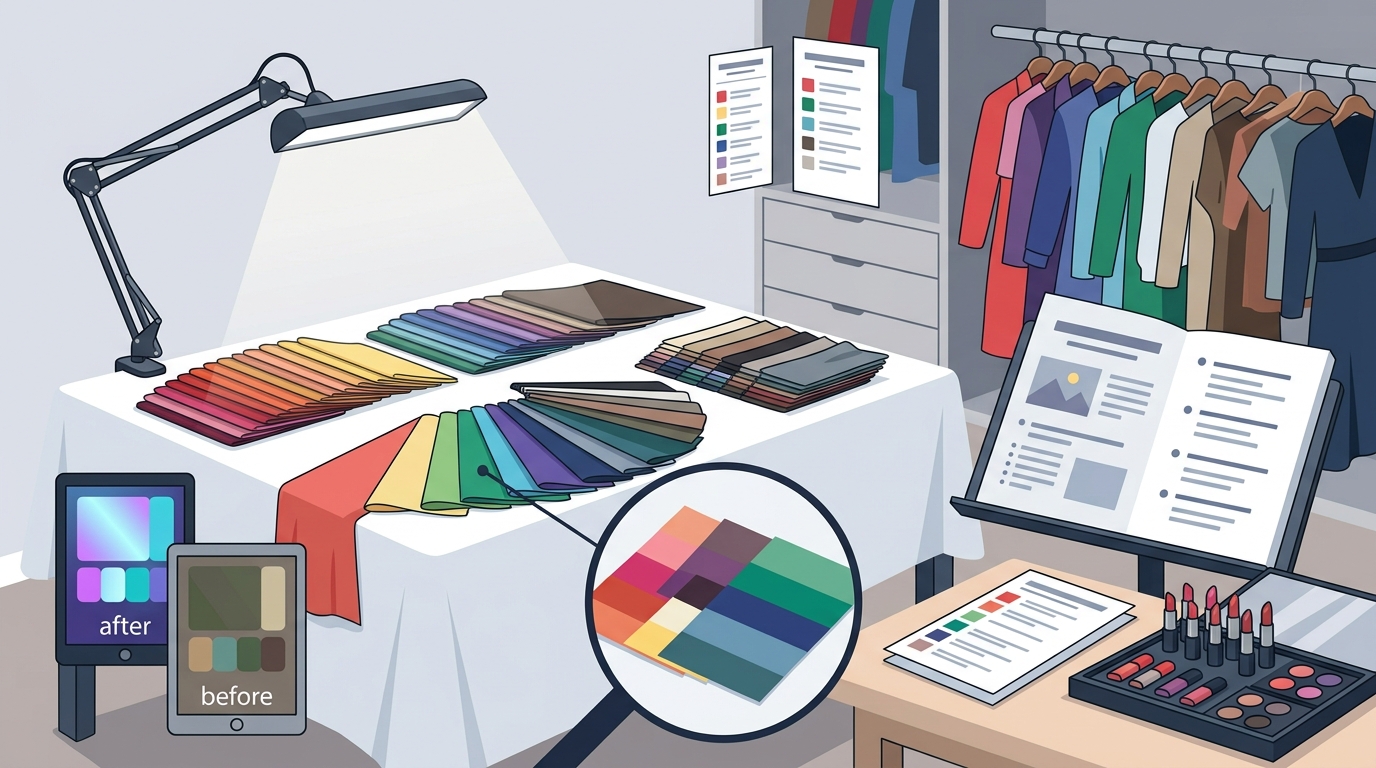
Daylight drape testing is a professional technique where a color analyst holds various fabric swatches next to your face in natural light. This method allows the analyst to see how your skin reacts to different colors in real time. It is the most accurate way to determine your color season because it accounts for the subtle interactions between your skin, hair, and eyes.
Why Natural Light is Essential
Artificial lighting can distort colors and make it difficult to see the true effect of a fabric on your complexion. Natural daylight provides a consistent and neutral light source that reveals how colors actually look on you. This is why professional color analysis sessions are often conducted in well-lit environments or during specific times of day.
The Draping Process
During a drape test, the analyst will move different colors near your face and observe changes in your skin tone, eye brightness, and overall appearance. They will look for colors that make you look fresh and vibrant versus colors that make you look tired or dull. This process is systematic and requires trained eyes to interpret the subtle shifts in your complexion.
Contrast Matching
Contrast matching is the practice of aligning the contrast level of your clothing with the natural contrast of your features. Your natural contrast is determined by the difference between your skin, hair, and eye colors. If you have high natural contrast, you will likely look best in high-contrast clothing. If you have low natural contrast, softer, lower-contrast colors will be more flattering.
High Contrast vs. Low Contrast
High-contrast individuals have a significant difference between their skin and hair, such as fair skin with dark hair. They often look best in bold, clear colors like black, white, and bright reds. Low-contrast individuals have a more subtle difference between their skin and hair, such as medium skin with medium brown hair. They often look best in softer, muted colors like pastels, earth tones, and soft neutrals.
Applying Contrast to Your Wardrobe
When shopping, pay attention to the contrast of the colors you are trying on. If you are a low-contrast person, avoid wearing stark black and white combinations close to your face. Instead, opt for softer neutrals like cream, taupe, or soft gray. If you are a high-contrast person, you can likely wear bolder colors without looking washed out. Matching your clothing contrast to your natural contrast helps create a harmonious and balanced look.
Key Takeaways
- Undertone is the subtle hue beneath your skin and is the primary factor in determining your best colors.
- The 23-Season system provides a more precise and personalized palette than the traditional four-season model.
- Daylight drape testing is the most accurate method for identifying your color season because it uses natural light and real-time observation.
- Contrast matching involves aligning the contrast of your clothing with your natural feature contrast.
- Wearing colors that clash with your undertone can make you look tired, dull, or washed out.
- A professional color analysis can help you build a capsule wardrobe that always works for your coloring.
- You do not need to throw away clothes that are outside your palette; you can style them with better colors near your face.
- Color analysis is a guide, not a set of rigid rules, and should be used to expand your wardrobe options.
Frequently Asked Questions
Can I determine my color season at home?
You can try to determine your color season at home, but it is often difficult to be accurate without professional training. Factors like lighting, makeup, and self-tanner can distort your results. A professional color analysis using daylight drape testing is the most reliable way to find your true season.
What is the difference between undertone and skin tone?
Undertone is the subtle hue beneath your skin, while skin tone refers to how light or dark your skin is. You can have a fair, medium, or deep skin tone and still have a warm, cool, or neutral undertone. Undertone is what determines which colors will flatter you.
Do I have to throw away clothes that are not in my palette?
No, you do not have to throw away clothes that are not in your palette. You can still wear them by using styling techniques such as placing them away from your face, pairing them with colors that are in your palette, or adjusting your makeup and jewelry to create harmony.
What is the 23-Season color analysis system?
The 23-Season color analysis system is an advanced method that breaks down the four main seasons into 23 smaller categories. This allows for a more precise and personalized color palette based on your specific undertone, value, and intensity.
How does daylight drape testing work?
Daylight drape testing involves holding various fabric swatches next to your face in natural light. The analyst observes how your skin reacts to each color, looking for colors that make you look vibrant and fresh versus colors that make you look tired or dull.
Can I wear black if it is not in my palette?
Yes, you can wear black if it is not in your palette. To make it more flattering, try wearing it below the waist, such as in pants or shoes, and pair it with colors that are in your palette near your face. This reduces the contrast and prevents black from overpowering your natural coloring.
How often should I get a color analysis?
You generally only need to get a color analysis once, as your undertone and natural coloring do not change significantly over time. However, if you have a major change in hair color or skin tone, you may want to revisit your palette to ensure it still works for you.
Conclusion
Stopping the cycle of buying clothes that make you look tired starts with understanding your unique coloring. By identifying your undertone, determining your specific color season, and using daylight drape testing, you can build a wardrobe that supports your natural radiance. Contrast matching is the final piece of the puzzle, ensuring that the colors you wear are in harmony with your features. For a personalized and accurate assessment, consider booking a session with ATX Color Studio in Austin, Texas. Their expert-led approach uses advanced systems to help you find your true colors and wear them with confidence.